

















In Home Care Services.
You choose the aged care services you need to continue living in your own home.


Access to home care services to support you at home.
With Lucky Care you get the control to choose the aged care services and services you want, when they suit you and at a rate you’re happy with. We help you use your funding on the best quality service, in your local area.
We know your independence is important, which is why we support you to get the right care, from the best providers to support your wellbeing and help you remain at home and in your community longer. The range of service we offer you through our HCP program, helps older people at at home longer.
Here are some examples of services you can access with your Home Care Package funds, depending on your care requirements (which will be outlined in your Care Plan).
Personal care
Support with everyday tasks that have become more difficult, such as grooming, showering, dressing and more.
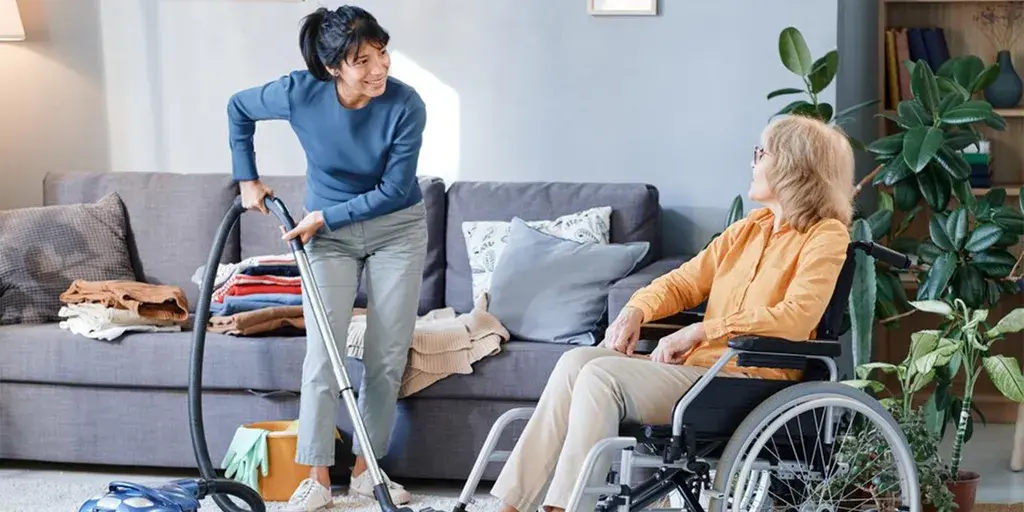
Domestic assistance
Assistance keeping your home neat and tidy, including vacuuming, mopping, laundry and tidying up.
Enjoy Lucky Care services.
We work with the top service providers all over Australia to offer you the widest range of care. With us you can trust, that you feel safe and support in the comfort of your home.
Social support
Helping you connect to your local community, friends and loved ones. Attend events or social visits.
Allied health & therapy
Connecting you to health services you need like speech therapy, nutrition support, occupational therapy and more.
Nursing care
Clinical support in your own home. Personalised care including continence management, wound care and more.
Respite care
Support for when carers need a break. We provide a much-needed change of scenery for both client and carer.
Why choose Lucky Care?
- Our free QuickStart service will get you set up in 10 days or less.
- Choice and control over who delivers your care.
- Over 10,000 local Care Partners to choose from.
- Innovative tools to help you manage your Support at Home funding.
How to setup your service?
Step 1

The first step is to speak with one of our Care Experts and we will discuss which option will best suit you and your care needs. If you have an Australian government assigned Home Care Package, we will support you to live independently with us, if not, we can still give you the highest quality advice to help you apply and find out if you are eligible for aged care services at home.
Step 2

Our friendly Care Experts will arrange the sign up documents for you to complete online so you can get your care services started as soon as possible. Once your sign up is finalised you will be assigned a Care Manager who will prepare your Individual Care Plan and Home Care Package Budget, specified to your unique care needs.
Step 3

And you’re ready to get your services started! With Lucky Care you have the ability to choose from our huge list of amazing service suppliers, or bring your own carers onboard. Depending on whether you self, part or full manage you will either set up services yourself or a dedicated Care Manager will do this for you to keep you independent and improve your wellbeing. You will get better home help with us.
How life is better with Lucky Care?
More choice and control.
With Lucky Care you have the choice and control to receive the services you want, when you want them, delivered by an expert team of carers that provides assistance that suits your needs.
Low fixed fee, nothing more.
Pay low fixed transparent fees from your government funding and nothing more. This is how we support you to get more from your Home Care Package funding so you have more hours of care available for your home care services.
Experts in self-management.
We were the first Provider in Australia to offer self-managed Home Care Packages. We help you wherever you are on your in home aged care journey to stay independent in your community. We have been helping our elderly Australians through a range of challenges and services, providing companionship through their golden years for decades.
The following services or items are outside of the Home Care Package program eligibility.
The Department of Health provided some guidance on approved spending and has given us some further feedback on particular services and items that the home care packages cannot pay for.
To make it easier we have listed some of these services and items below:
- General home services that were never, or are generally not completed independently prior to age-related functional decline, including home repairs/maintenance/specialist cleaning performed by a tradesperson or other licensed professional.
- Food (except as part of enteral feeding requirements or items listed under food for special medical purposes as per the Australia New Zealand Food Standards Code – Standard 2.9.5).
- Home insurance.
- Rates.
- Water, sewage, gas and electricity costs.
- Private transport related costs including vehicle registration, vehicle repairs, vehicle insurance and petrol.
- Local transit costs of public bus, ferry or train fares.
- Funeral plans / insurance costs.
- Pet care and associated costs such as pet food; registration; taxidermy, cremation.
- Internet and telephone costs, exceptions include:
- Care recipients who are homeless or at risk of homelessness (as identified in a care recipient’s ACAT assessment) can use Home Care Package funds for the ongoing monthly charges to ensure connection with service providers.
- Care recipients who require the internet or landline to support delivery of medication management, remote monitoring service or delivery of an included service on the phone can use Home Care Package funds to set-up telecommunications connections (e.g., to get internet connected).
- Beauty therapy (e.g., manicures) and hairdressing.
- Cost of entertainment activities, such as club memberships and tickets to sporting events.
- Travel and accommodation for holidays.
- Supplies to participate in any activity, e.g. gardening or craft.
- Using Home Care Package funds to pay for solicitors or accountants for maintaining care recipients’ personal affairs.
- Funeral costs and funeral plans.
- Gym or pool memberships/access costs when not prescribed for aged-related functional decline and monitored by health professional operating within their scope of practice.
- Assistance with home purchase.
- Mortgage payments.
- Rent.
- Permanent residential care (subsidised or private) and residential respite (subsidised).
- Heating and cooling costs (installation and repairs).
- Whitegoods and electrical appliances (except items designed specifically for frailty such as a tipping kettle).
- Household furniture and furnishings:
- Lounge suites and recliners which do not support a care recipient’s mobility, dexterity and functional care needs and goals.
- Other general household furniture such as coffee tables, wardrobes, and bookshelves
- Massage chairs when not prescribed by treating medical practitioner and/or allied health professional.
- General mattress and frame for bed (exceptions for pressure relieving mattress or mattress/frame for an electrical adjustable bed or hospital bed)
- Replacement/maintenance/servicing/cleaning of:
- Water tanks.
- Solar panels.
- Fencing.
- Roofs.
- Heating and cooling or hot water systems.
- Swimming pools.
- Home modifications or capital items that are not related to the care recipient’s ageing-related care needs, for example:
- Windows, roofs, pergolas, sunrooms, decking.
- Home modifications that don’t support ageing safely e.g., non-accessible bathroom and kitchen modifications; non-standard fittings in accessible bathroom modifications (e.g., mosaic tiles).
- Home modifications requiring development applications.
- Aesthetic modifications of any kind.
- Repainting the home.
- Major plumbing.
- Emptying of septic tank; remedying sewage surcharge (matter for water company/insurer).
- Major electrical work, e.g., rewiring house.
- Replacement of entire floor and floor coverings throughout the home unless safe passage for mobility equipment required or slip hazard reduction required, as recommended by a health professional for care recipients at risk of falls.
- Replacement of foundation e.g., concrete/cement slab.
- Significant changes to the floorplan of the home, such as adding a new bathroom or extension.
- Extensive gardening services such as:
- Planting and maintaining crops, natives and ornamental plants.
- The installation and/or maintenance of raised garden beds.
- Compost heaps.
- Watering systems.
- Water features and rock gardens.
- Landscaping.
- Tree removal.
- Removal of garden beds.
- Removal of shrubbery (unless preventing safe access and egress).
- Defined at section 52D of the Aged Care Act 1997.
- Includes income tested care fees, basic daily fees and additional fees.
- Co-payments for state/territory government funded programs, such as subsidised taxi vouchers and/or aids and equipment schemes.
- Dentures, dentistry and dental surgery.
- Prescription glasses or contact lenses.
- Prostheses (e.g., artificial limb).
- Spectacles.
- Hearing aids available under the Hearing Services Program. Contact the Hearing Service Program (HSP) for guidance on hearing aid replacement and delegate approval for non-standard hearing aids. Exception if care recipient is not a pension concession card holder as Home Care Package may cover like for like of typical hearing aid covered by HSP in this case only.
- Continence aids if a participant in the CAPS program.
- Diagnostic imaging.
- Natural therapies, including:
- Alexander technique.
- Aromatherapy.
- Bowen therapy.
- Buteyko.
- Feldenkrais.
- Homeopathy.
- Iridology.
- Kinesiology.
- Naturopathy.
- Pilates (except sessions supervised by an exercise physiologist or physiotherapist).
- Reflexology.
- Rolfing.
- Shiatsu.
- Tai chi (except sessions supervised by a Chinese Medicine Practitioner, exercise physiologist or physiotherapist).
- Western herbalism.
- Yoga (except sessions supervised by an exercise physiologist or physiotherapist).
- Payment for informal care – a Carer’s Payments is available to fund the support of family and friends.
- Section 16.1 of the Home Care Packages Program Manual specifies more information about what ageing related programs can and cannot be accessed while receiving a Home Care Package.
- Debit cards (unless the provider has rigorous systems in place to vet every payment and keep on file all receipts in accordance with the Records Principles 2014. Debit cards may pose issues for GST credits. Consult with the ATO for more information).
- Cash payments or gift vouchers/cards, including online vouchers and coupons.
- Transfer of subsidy into care recipient or their family’s personal/business bank account without rigorous acquittal by provider of funds against receipts matched to the Home Care Agreement, care plan and individualised budget in accordance with the Records Principles 2014.
- Payment to families and friends for care services are typically a program exclusion. Family and friends may instead access the Carer’s Payment – https://www.servicesaustralia.gov.au/carer-payment
- Using subsidy to pay for family carers raises serious probity issues under the Public Governance, Performance and Accountability Act 2013 under which the aged care special appropriation sits – generally this is an exclusion unless it is a thin market (i.e. rural and remote Australia; Aboriginal and Torres Strait Islander and CALD populations) and the family member is especially qualified, does not live with the care recipient and the provider and family member (in their capacity as a personal care worker or health professional) have agreed a robust probity plan with the provider. It is a strict exclusion if the family member is already receiving a Carer’s payment.
- In relation to meal services and whether food can be included in a Home Care Package:
- Preparation and delivery of meals can be included.
- The raw food component of those meals cannot be included, except in the case of enteral feeding.
- The Department has not mandated a standard split/ratio for the raw food component. This is a business decision for the company providing the meal services to calculate how much the raw food component is. Home care providers should discuss with the care recipient the amount of the raw food contribution, as well as how and who it is paid to, as part of the negotiation with the meals provider and the care recipient.
Book a free tele-consultation.
Want a phone call with our team at a time that suits? Our free consultation call with a dedicated Care Expert will give you more information about Home Care Packages, our different care models, aged care and answer any specific questions you have. Whether you are looking for companionship services, meals, carers, general education or have friends who have mentioned us to you, we will listen to your specific care needs and explain the options available to support you to live at home.
Interested in specific home care services? Let us know.
Select a date and time between Monday – Friday, 10am – 4pm (AEST), that suits you to meet with one of our Care Experts. They will give you a call on the phone within half an hour of the time you select.
Come along with any questions you have, and we will help guide the way.